A ledger for insights
"Do no harm." - Hippocrates
"Be kind whenever possible. It is always possible." - the Dalai Lama
Sunday, October 26, 2008
Djerassi and Houellebecq
I wrote earlier about my disappointment with Djerassi's "science-in-fiction". I would point him to the much more effective and artistic Houellebecq style, directly descended from Aldous Huxley, but done with much more panache (bien-sur). It is over the top in some of its narrative descriptions of extreme behaviours, deadpan and not suitable for every audience, but if I were to recommend some books for anyone studying human motivations (and that includes business types and techies, not just the humanities majors), it would be "The Elementary Particles", "1984" and "Brave New World". They talk of biology and power and the link to human affairs. Free will is mediated by biology and biology is the layer just below power.
Sunday, October 5, 2008
Kundera talks with Houllebecq
I am tempted to write a fictional dialogue between Milan and Michel. Their world views and attitudes to sex are ripe for collision. Michel finds it challenging and Milan could not find it easier. Michel is looking for connection and so is Milan, but in such different ways. One lives in a sensual existential world, the other in a world of isolated points with possible lines. What triggered the idea was the change in the title of the English translation of Les particules elementaires from Atomized to The Elementary Particles in later editions. Kundera had written essays on how not to betray an author when translating, and he advocated simple direct non-interpretive translation to avoid adding extra semantics. And then I thought about how Kundera writes of sex and how Houllebecq does too, and how both see it as light, but in such different ways. They need to talk.
Thursday, October 2, 2008
Towards the holy grail of integration
Where the machine does most of the interface and field mapping work. SOA promises to help with this, but it depends on the old chestnut of trying to "agree on a schema" which is a barrier to flexibility of semantic expression and denies potential interaction that keeps humans in the loop. Think of how angry forms make most people feel. I am increasingly beginning to believe that true automated integration is an AI problem and probably its killer app. A job for Google. They may even call it something like Ploogle-and-play.
Software engineering and hazing
Maybe the reason engineering faculties used to have such painful initiation rituals was that they (unconsciously I'm sure) wanted to drum into you that there was a culture here, you had to adhere to the body of knowledge that existed, that was developed, and that you could not "come in arrogant". This is different from computer science, where everyone is de facto arrogant and knows everything. And when you get old and wizened in the IT world, you try to maintain your influence by going into management, and the continual flow of new technologies keeps coming, almost as if to prevent experience with the details from continuing to grow, to maintain the arrogance of the new, a bubble effect really.
Ultimately it is only experience that counts :
Ultimately it is only experience that counts :
what you say I forget,
what I say, I remember,
what I do, I understand.
Tuesday, September 30, 2008
Palomar's Hale Telescope
Finished reading Ronald Florence's "The Perfect Machine" about the project to build the 200 inch telescope. A couple of things struck me.
- The most interesting characters are the ones who are presented as being the most problematic, for example, Edwin Hubble and his huge ego, or Fritz Zwicky and his crazy sounding lateral thinking. Both are presented in a somewhat worse light than the "reasonable" folk like George Hale. Cooperation and cooperative people get things done but the competitive bastards are the ones who are valued more if they manage to prove something. I guess it is because the competitive route is more risky, more likely to move the culture in new directions, painful as it may be to the culture.
- The other striking insight has to do with a line near the end of the book that mentions that charged-coupled device (CCD) sensors are so much more efficient than film for capturing light that a one meter telescope today could do what the 200 inch one did with film. This is certainly an example of disruptive technology, given the herculean efforts made to build the Hale machine, with its precision movements and optics. Of course CCD's can be used with the 200 inch mirror, but one must wonder if such efforts would have been made if CCD's had been available in the 1920's.
Monday, September 29, 2008
Science in fiction
A review of the Bourbaki Gambit
I am surprised that a prestigious imprint like Penguin would accept The Bourbaki Gambit as a novel. It is an uncomfortable advertisement for its author at best and at worst an insult and a slight to the artistic process by a scientist too conceited to realize it. Djerassi, who made discoveries which led to the birth control pill is branching out into a style he calls science-in-fiction. He writes of scientists and of their egos, a bit like C.P. Snow, but with much less art. He revels in showing off his observations of fancy places, but really only manages to show his limited world view. Capri, Manhattan and cliches about vacation resorts.
I guess someone who has achieved so much in science may be excused for thinking that art is something secondary, and this is exactly what writing this novel and sponsoring the arts indicates.
Friday, May 16, 2008
More on COTS vs custom software
 Lausanne Flon Copyright 2002-2008 A. Barake
- The "normal" upgrade cycle for vendors is often strategic and is driven by internal rather than external compatibility – upgrades also tend to break interfaces regardless of intent, it just does not help that the intent to play well with others is often at odds with large company policies (i.e. marketing strategy), especially when their suite of products covers many functional domains
- Integration requires glue, and glue can either be COTS or home grown. For COTS, see above objection, and add cost. Home grown defeats the argument of using COTS in the first place Q.E.D.
- Maintenance is dependent on knowledge, but unless you are writing in APL (and even then), the pool of developers with expertise usually exists; reading code and fixing it is what they are hired for and have some training in.
- Developers in my experience much prefer to work on code where the source is available than integrate stuff using configuration and proprietary tools where the options are limited and the dependency on documentation and vendor support is limiting
- Code is now pretty much commoditized except in specialized areas (telephony switching, military stuff, embedded stuff) and even then… there are only a handful of approaches that people use to write and maintain code and most good developers can immerse themselves in a code base within days of weeks and make it their own.
- Renewal is key, and owning a system and renewing it by adding features is easier with home grown that has few integration points with COTS than with disparate COTS on different version cycles with glue in between.
UNIX and other open system approaches have and are trying to tackle the problem through factoring out of common functional requirements into modular technical modules and protocols, and have had some success in advancing the state of the art – the Internet and its associated protocols and services are a direct result. The OSI stack is a manifestation of this approach and has become a pattern of understanding outside that world.
One approach is to layer the commercial stuff and isolate it from other commercial stuff through standard gateway mechanisms, off the shelf if you like, and these include queues, UNIX gateways and subsystems that use HTTP, SMTP and LDAP, xDBC as well as XML protocols where practical and where translation mechanisms are easy to obtain (message brokers, AJAX, browsers, SAML…) At another level we should be writing our own application code to use these underlying systems and the glue should be at the application level – i.e. SOA – services are COTS with standardized interfaces, applications are not.


Monday, April 14, 2008
Les mots
 A Baja beach, bay side, Copyright 1988-2008 A. Barake
I was asked by my son about the meaning of the word "load". The context was "load the car". As I explained, by giving an example ("load the bags in the car"), I realized that the example provided an instance that could be generalized, but that was inherently ambiguous outside the continuity of experience. One has to have loaded things to understand that bags are just things, and we can extend the concept, and then we can even go further and talk about "a load" as a thing that is "loaded", without ending up in an infinite recursion.
You know where this is going...
Machines need to have exact mappings of symbols to "actions". Actions are just other symbol manipulations. So we have mappings and more mappings and rules and context and all the fodder of Minsky-type AI. Not good enough it seems. Gelernter and others have realized that one must be embedded in experience to have "knowledge". Husserl and Heidegger said it much earlier, but disciplines rarely cross. So we are realizing now that cognition is a sort of misnomer, we need a word to talk about "knowing", or better still "questioning" to get to a model of reality that is useful.
All this can lead to better and more flexible interface design for a start. Imagine a handshake that allows systems to agree on field semantics and field syntax for data exchange without all that WSDL baggage. Give me a couple of ports and go for it. Virus and spyware writers are now writing the primordial soup that will lead to these higher organisms one day.
Sunday, April 13, 2008
Intel and MS

I remember attending another launch, back in the early 1980's - it may have been 1983 - when Windows was just becoming real. It was in Seattle, and Bill Gates was talking to a relatively small audience. Many of the cooler attendees were typing on Tandy Model 100's and making annoying key clicks.
Bill said something that was surprising to me at the time, that he predicted that Intel and Microsoft would become the dominant presences on the desktop. You have to remember that back then there were lots of contenders, including the new Mac, the really advanced Amiga and many other smaller players, and Bill's statement seemed preposterous to me, since his DOS was so primitive and Intel's 8088 was nasty to program, slower than the 6502 (except in clock rate) and not at all like the PDP-11 (which was something the Motorola 6800 and later 68000's were aspiring to). Some of us were even aware of Unix and its possibilities on the desktop.
He was right of course, but I think that he made the prediction come true, rather than actually saying something that made sense. His tactics and acumen forced the issue, and the contenders mostly disappeared, except for Apple. Despite being technologically inferior both the CPU and the UI he promoted became dominant. He saw that business decisions were not made by techies, even in the emerging micro world, but by risk-averse non-techies who prefer a brand name to any technological advantage.
I guess that is why he then started to draw huge audiences.
The Guardian and Harry Potter
 The Alps at New Year seen from the northwest Swiss side - Copyright 2003-2008 A. Barake
I wrote earlier about a Nick Lezard Guardian posting that strongly criticises JK Rowling's prose. Recently, there has been another Guardian article about the prevalence of Oxford and Cambridge graduates in English public life. There may be a link between the two. JK Rowling did not attend these prestigious schools, yet she writes about them in the Potter books - in fact King's College at Oxford was used as a setting in some of the earlier films. So is Lezard unconsciously chaffing at the gall of it all? She is successful, very successful, and yet she does not come from the rank of the elite, she did not attend Oxbridge.
I like the Guardian, I think they are very balanced and fair, but there is a snobbery factor there, which, I am guessing, comes from this elitist attitude that is probably part of the legacy of such a prestigious education. The few graduates (less than 10) of these schools that I have met have been overly dismissive and difficult when their opinions and statements have been challenged in a social context such as a meeting or workshop. A lot of clever sophistry has been put on display to discredit their interlocutors during such occasions. Debating skill is a good thing, but taken to excess can be quite offputting. So I will probably remain prejudiced until I gain further experience in the matter.
The Network is NOT the Computer?
 A hurdy-gurdie at the Victoria and Albert Museum in London.
I’ve recently attended Microsoft's launch of their 2008 suite of products, including Visual Studio. It was held in a movie theatre where there were two presentation streams, one for IT Professionals and one for Developers. I attended the developer stream. Very little PowerPoint and lots of live demos with code snippets being included in the examples. Visual Studio now supports Javascript as a first class citizen. This drew applause. I guess it was a sorely needed gap in IDE’s. I wonder if Javascript will become (more) fragmented as a result.
The integration of desktop presentation with the network, with attendant DRM-enforcing security as well as extensions to browser functionality is overwhelming and integration of desktop with network apps is almost complete; they are ready to link their OS and .Net environments to Internet content in a seamless way - the network is NOT the computer was the loud subtext. In fact they have made it possible to decouple the presentation layer of an application from the server side so that it works either through a client-server virtual desktop (think Citrix-like), through a regular-looking window, or through a browser.
This is resistance to the Google model, where the client is as thin as possible and standards are used as they should be. The gamble with the MS approach is that users will be sufficiently attracted to the extra features of a tighter integration to the desktop to pay money for it. Makes sense given the business model.
There were also a few intro videos at the start of the various sessions, and the most humorous included a therapist and his patient discussing the relationship between a developer, his machine, the tools and the operating system. Here, the unstated subtext was that colourful computer cases, slick hardware design etc were no match for technical flexibility and ego-boosting developer learning curves (a jibe at Apple I guess). Shakespeare wrote that wisdom comes alone through suffering, which may explain why hazing works to bind a group, and may explain why people who adopt product lines like IBM’s and Microsoft’s end up defending them so strongly. I think it is a case of confusing the side effect with the cause.
Tuesday, January 15, 2008
Brad Warner

I have been reading Brad Warner's book Sit Down and Shut Up! about Zen. His writing makes me think he is a kindred spirit. The book is engaging, very funny, and down-to-earth and it somehow manages to transcend the words and project the deep essence of the Buddhist meanings he wants to convey.
Brad is a Buddhist monk and a teacher. He also plays bass and writes columns on the Web. He writes about how his Buddhism allows him to react in a balanced way to situations and to people that may be frustrating or annoying. However, I get the feeling that he is still fighting the demons that assail us many of us, the ones having to do with pride and with having the last word. I guess that one aspect of enlightenment is the destruction of that urge, or at least its domestication.
What got me thinking about this was one of his Web columns, responding to a label he acquired for his association with the Suicide Girls site. That he responded at all was indicative. I often feel the same, some energy has to dissipate when one feels wronged. The state I am trying to attain is one where I don't feel wronged in the first place.
The other coincidental event that got me going along this train of thought was a funny excerpt from a diary-joke-agenda that suggested ways to "annoy the Dalai Lama". I don't think any of those methods would work, but they are so funny that they contain their own flaw; and the solution to this little problem: humour.
I think Brad knows this, and that is why his books are so great, the jokes are part of the religion. What other religions have jokes so deeply embedded (I know of only one joke in the Bible - about Peter being a rock to found the church on, and that one is really a pun that only works in Latin and its derivative languages)?
Wednesday, December 12, 2007
Miscellaneous and funny
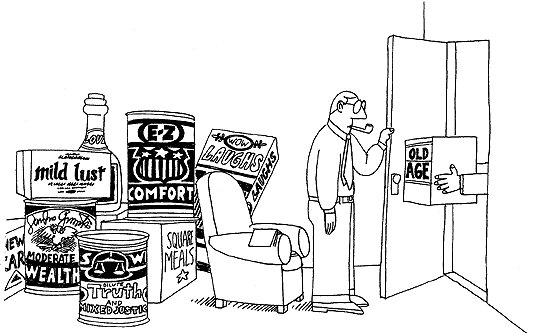
(Cartoon by B. Kliban)
- A back page from Esquire that is now on the Web: What I've Learned, by Satan. "I hung a "WELCOME KEITH RICHARDS" banner down here every day for 40 years. Eventually I just gave up."
- Differences between men and women: In the locker room, men talk about three things: money, football, and women. They exaggerate about money, they don't know football nearly as well as they think they do, and they fabricate stories about women. Women talk about one thing in the locker room -- sex. And not in abstract terms, either. They are extremely graphic and technical.
- B. Kliban cartoons
Friday, November 30, 2007
Joseph Conrad
A wonderful article on Conrad in the Guardian, which contains this quote from the man:
"Fiction, at the point of development at which it has arrived, demands from the writer a spirit of scrupulous abnegation. The only legitimate basis of creative work lies in the courageous recognition of all the irreconcilable antagonisms that make our life so enigmatic, so burdensome, so fascinating, so dangerous - so full of hope."
An enlightened grade 10 teacher made us read Heart of Darkness - and it was way beyond us - yet how could we not feel the depth of his style, his circling of the story and the way the words were like ruminations of the subconscious. Re-read it several times since, and it never ceases to bring forth strong emotion. And this is not a sensual book, but almost a pure intellectual one - wrapped around a journey - a river trip.
And don't miss - in the same issue - an interview with Richard Ford.
"Fiction, at the point of development at which it has arrived, demands from the writer a spirit of scrupulous abnegation. The only legitimate basis of creative work lies in the courageous recognition of all the irreconcilable antagonisms that make our life so enigmatic, so burdensome, so fascinating, so dangerous - so full of hope."
An enlightened grade 10 teacher made us read Heart of Darkness - and it was way beyond us - yet how could we not feel the depth of his style, his circling of the story and the way the words were like ruminations of the subconscious. Re-read it several times since, and it never ceases to bring forth strong emotion. And this is not a sensual book, but almost a pure intellectual one - wrapped around a journey - a river trip.
And don't miss - in the same issue - an interview with Richard Ford.
Monday, November 26, 2007
More on automated interfaces
- UNIX philosophy of universal read, write, create (sic), seek verbs is akin to financial transactions, where bytes are analogous to money
- HTTP extended this with POST and made it stateless - so it becomes a client-server protocol (a good alternative to X-Windows by the way)
- The universal currency is data, and it can contain anything, it can buy anything. Putting meaning to it is really the difficult part, and the notion of objects is really an attempt at creating a philosophy of data
- Right now we have an inflation of data, too much currency, and its value is being balkanized, some currencies are more precious than others, security related ones, and maybe some video or music bytes. Copyright is an attempt at increasing the value of bytes through currency control.
- So if an object defines the methods we can use to manipulate it, then one way to have objects communicate more easily (ideally automatically) is to constrain what objects can do to a machine manageable set. This may not be much of a constraint, only one that promotes efficiency through consistency.
- Or we can take the idea behind types to heart and have a huge catalog of types and ensure that they can play together - real types which map to useful objects
- For example, a user at any terminal could drop select from a list of things like ADDRESS CHANGE, VALIDATE ID, SUBMIT CLAIM, BUY, COMPLAIN, CHANGE FIELD, etc
- This is the "naked object" philosophy taken one step further. No need for a graphical interface, just a nice "no error" interface - where all choices that work are shown. The "trie" of possibilities would reduce itself as transactions are chosen to interact, limiting the choices the more you decide
- In short, modeling. Can this work in an ad-hoc world? Maybe the modeling should be automated through affinity and tuple-space approaches to ad-hoc property lists
- This, coupled with a hierarchy of state machines (like game play AI) would go a long way to creating automated interface coupling.
Friday, November 23, 2007
That SOA thing

Here is the definition from an authoritative vendor-neutral body:
The World Wide Web Consortium’s glossary defines Service Oriented Architecture (SOA) as
"A set of components which can be invoked, and whose interface descriptions can be published and discovered"
Note that the definition does not talk about the type of transport, it is all about interface descriptions – Web services are therefore a subset.
As in all such interface standardization efforts discovering the service (semantics) is key.
How to make apps talk to each other meaningfully (semantics and syntax) without a human in the loop is a problem old as operating systems.
This has been and remains the “holy grail” of integration. Getting apps to talk across their boundaries has been a staple of data processing since I can remember.
We have had shared memory, files, networking, RPC, CORBA, and the now the latest idea is to re-use the Web servers connected to apps as Web services by parsing the HTML or XML to understand the context of the data across HTTP [We seem to be adding layer after layer of code to do this for some reason. Maybe with the hope of adding some sort of “intelligence”, maybe not…]. When we only use TCP/IP interfaces instead we generalize and call it SOA. This tells us that TCP/IP is now a commodity layer. It is all about commoditization moving up the stack.
In all cases we need to make the plug for the socket and make sure the voltages are OK; i.e. the syntax and semantics have to work across the boundary.
The Web has given us a new way to think about this.
Links – URI and URL’s
SOA is the idea that an app can “choose, click on, and follow a link” by itself to get a job done – and sometimes fill forms too.
There are 4 major verbs we can apply to URI’s and URL’s: GET (click), PUT (put up a resource), POST (fill-in a form mostly), and DELETE (get rid of a resource), plus a few more: This is HTTP. It is meant to stateless (except for cookies and URI-held sessions ….) because the state is supposed to be held by the user – and when the client becomes an app, that can complicate things greatly – all of a sudden you have servers talking to each other with state.
Still, we have not progressed to semantics at the app layer – this is transport and syntax.
We have always depended on humans (programmers, analysts and users). We have been doing this – imperfectly – first through command line, shell scripts, GUIs, and now Web pages and forms.
When you cut and paste, when you embed a table or a picture into a document and when you save a file to be retrieved by another app you are doing inter process communications. Windows and GUI’s allow us to do this more easily, with visuals– it may be their most obvious value proposition – the basis of the MS empire. The Web is similar, we press on links to hop among and between servers and apps.
Computers, on the other hand need to be rote taught. They can crawl web sites, but they have difficulty making them inter operate without humans writing the glue. Web 2.0 is about doing this more easily – “mashing up” service interfaces using XML and HTTP and the smarts of a browser scripting language – ECMAScript (JavaScript)
SOA ideals say that we can publish somewhat constrained specs that will allow machines to automatically selects forms and links and act on them, even when that they may never have seen before.
The more realistic approach is to say that we will need humans to guide the machines, but that the molding of sockets and plugs will get less onerous – we are attempting to standardize the interface syntax and restrict the semantics to a published, well managed, machine-discoverable set. In the interim, it helps us integrate stuff with less work.
Monday, October 29, 2007
Dysfunctional requirements and IT ideology
 |
| From my flickr |
Saturday, October 27, 2007
Skin tone deaf
 Before the ferry - Copyright 2007 A. Barake
Friday, September 28, 2007
Book review - A History of Warfare

It was published just after the first Gulf War, and contains optimistic comments about what seemed to be a limited offensive. This was an unfortunate example of wishful thinking, since the book, although otherwise well balanced, does not seem to want to believe in the recent possibility of extreme escalation.
The statement above is unfair, but it reflects my disappointment, since I remember those days very well. These were the times when Gwynne Dyer, another distinguished historian, had a CBC radio series on how the world was getting better. His reportage indicated that there were less and less big wars. I will be reading his book on war soon.
Things have changed since...
The Keegan book is a comprehensive analysis of the culture of war. It is generally cautious, erudite, and wide-ranging. Its coverage includes what we can gather from prehistory, from isolated cultures, from Western and Eastern traditions, and it analyzes cultural, anthropological and biological factors to define what is meant by "war". It provides a framework for defining war across cultures and religions and observes that war is often self-limiting, but not always.
It is also an attack on Clausewitz's dictum that war is an extension of politics - an extreme in a spectrum. In fact Keegan links the adoption of Clausewitzian philosophy to the Great War.
He makes a strong case. Total war does not seem common in history or prehistory, although it does occur. It is certainly not a survival mechanism for cultures! Its ultimate realization in the atomic age is a tragedy and he also makes the point that it cannot be considered politics by any stretch of the imagination, unless we simply consider it deterrence, which is a strange way to look at it.
All in all, it does illuminate the reality of war and does not make it seem inevitable, yet more must be said about the adoption of a Clausewitzian view in a world of measurement and power games. If a tool like total war exists, it will be used in certain cultures of escalation. I think that positivist materialism provides that context - ironically enough.
Sunday, September 23, 2007
Vico and iterative design - History as a spiral

Giambattista Vico was an Italian 17th century academic who wrote about history scientifically. His thesis is that history is a helix, and that the we can know history better than we can know nature because we make history. It is the New Science.
History is iterative design, in short. We are creating our cultures through spiral cycles of successive approximations. There is no overarching strategy, only tentative approaches, herding of instinct by the powerful, and some imperfect knowledge of the past that gets better as we approach the present.
Iterative design is the norm. Anything else is just so much hubris.
Waterfalls mostly create entropy.
Monday, September 17, 2007
The Art of (tech) War

(photo copyright 2007, A. Barake)
Where I talk about more-or-less obvious but infrequently discussed strategies by Sun, IBM, Microsoft et al.
I think it was in during the last century, with the advent of the hardware/software dichotomy that this type of strategy evolved. IBM may have been the first to use it successfully. A prerequisite is a pair of complementary things to sell, with at least one that you control completely, through secrecy, patents or a huge market lead. Let me describe it.
Suppose you sell hardware, and you make and sell software for it too. Your competitors also sell hardware and software of course. Your hardware is different and possibly proprietary or difficult to clone or to re-brand. So the strategy is to make software that runs on both your own and your competitors' box. You under-price or give away the software, and call it bundling.
Better still, you give away stuff that is almost or as good as your competitor’s, and you value-add and sell a version that runs only on your platform.
Sounds familiar?
IBM with Java and Linux
Sun with Solaris
And both are also attacking Microsoft with Eclipse and OpenOffice respectively.
Yet Microsoft thrives.
Explain in 2 pages or less....
Microsoft fights back using another strategy; they sell software that runs mostly on smaller cheaper platforms. They have an arrangement of co-dependency, as their releases grow and become more bloated, they require bigger and bigger Intel horsepower, until that low-cost hardware begins to overtake the computing power of big boys. This is an attrition strategy; much vaunted in management theory courses.
Microsoft's core business is software, so it is the protected commodity. The hardware is Intel, but multi-vendor and commoditized so competition drives the price down below the proprietary guys’ stuff. They are pursuing a software-first strategy and the other guys are pursuing a hardware-first strategy. Are you still with me?
It is with reason that IBM fears Microsoft more than it fears Sun or HP.
IBM and HP also sell Intel servers, but they are branded, not commodities. Both try to mitigate the hardware-first exposure by also making money on professional services (which can sometimes be an adjunct to sale - nudge nudge), server software and very big boxes. Forced upgrades due to byzantine dependencies among their software offerings help too, and the upgrade cycle is one way to drive this.
IBM has little software presence on the desktop except with IDE’s and I’m not sure they sell workstations since the Lenovo deal. In other words, they threw in the towel for now.
On the Internet side:
The classic version of this story is, of course, Microsoft vs Netscape, where hardware becomes system software and software becomes the browser. We know who won.
More subtle, as chronicled by others before me, Google learned a thing or two from this. They give away email, blogging, API’s, server side apps - to counter Yahoo’s offerings in that space. Free and easy Web access for the masses, no emphasis on paid subscription modes, whereas Yahoo does act as an ISP. Google’s core business depends on search and on page views, all the rest of their offerings simply draw customers into their portals while at the same time undermining Yahoo’s non-search businesses. They are not evil but almost...they followed in the footsteps of the well-tried IBM and MS strategies.
Yahoo - has no strategy that I can tell. They are like Sun. Java was a gift to the community that hurt Sun, since it is platform independent. I guess they thought that they could make an OS/hardware combo that ran the JVM better than the other guys, but IBM with its marketing (and technical) clout claims that that is not the case. In a way, it is as if Microsoft had written Linux. That is what happens to a nice earnest tech company that swims amongst the sharks.
Is their hope for the "good tech" to overcome the "mediocre tech" with good strategy?
My proposal would be combine the Apple, Sun and Yahoo brands as the high-end stuff of computing. The champagne. Then market it to consumers and businesses as the cream of the tech-savvy crop. Apple and Sun are an almost perfect match, and it would get Apple into that server market they so covet. R&D would be a plus rather than a risk, since the audience would want to take those risks, it would be cool, fodder for the early adopters. Yahoo would provide even more channels for Apple’s media side
There. Free strategy. Why don’t I command the multi-million dollar bonus?
I know many tech types who can't bring themselves to believe that that kind of “deep thinking” goes on; but this is exactly what the people who took biz courses when you were toiling to understand complex stuff end up doing, and they make the big bucks. Hustlers, thugs, ruthless opportunists... having the only kind of fun they can, since they can’t make things, are too competitive to collaborate with anyone, and certainly can’t code. I think they are missing out, because in the end, what's left is an abstract and hollow victory, scorched earth, and lots of resentment against inferior technologies. Real satisfaction can only come by making things better, and not just in the monetary sense as noted here. The alternative is growing entropy until the next cleansing crisis.
P.S.
This just in.
Friday, September 14, 2007
Dylan and Drake - Ego spectra
 (Picture copyright A. Barake, 2007)
Dylan's interviews and songs reveal a different type of ego, one that is dominant, defining of a reality. The person is re-invented with every appearance, and is making us consider adopting some of this vision.
This spectrum of ego - from the struggling and disappearing one to the inventive, playful and somewhat monstrous one is particularly interesting given that these are solo artists, both very original, defining themselves in the difficult music business. The support of others is limited, until you break through. Your belief system is mostly held near your heart.
In Dylan's case, the media circus and controversy tried to take hold, and he built a humorous shield to deflect the ego distorting forces and to maintain his creative force.
Drake was trying to break through and seems to have been struggling against his handlers as well as himself. He was more alone, in a sense, than Dylan, or at least not ego maniacal enough.
As ego is questioned, depression sets in. An argument can be made that depression in a loss of ego, a flattening of it that leads to inability to make the future for oneself. A strong ego influences destiny (character is destiny) by changing the perceptual environment. Management types would call it "selling yourself", missing the underlying irony.
It is easy to sell a template ego, for example the "MBA persona", or the jock persona, but in the arts, individuality and novelty are the goal, so the frame of reference gets pretty narrow, the market too. Success means enlarging that frame, creating the market. Dylan did it through force of character, strong confident performances, new poetic lyrical modes, and hubris. Drake did it too, but with his music and style. It took longer.
For most of us, the ego is sustained by our family, our friends and to some extent our peers at work. We adapt to these micro-cultures (or not) when we interact. Depression can occur when there is indifference or forced adaptation that violates beliefs and upbringing.
It is therefore important not to let any erosion of the ego occur through lack of self-respect. Unfortunately, our ape behaviour is all about climbing the ego ladder, and this erosion is all too common in groups.
Solitary artists, like writers and the afore-mentioned performers sustain the ego through their art. The songs are externalizations of the ego, and provide a hedge against the erosion. Criticism of the songs can be destructive for that reason. I think Drake was very susceptible to this (from my reading of Boyd's memoir of him). Dylan would be too, but then the songs are held up by all the fans and many have become classics - he is immunized.
Logic of opposites
 (Picture of Lausanne Park copyright A. Barake)
Math and logic try to resolve these ambiguities by making distinctions between converse, complement, and other technical relationships, that have something to do with oppositions. The usefulness of these constructs depends on their generality and how they fit within the meta-world of math operators and relationships - set theory etc. Why this is satisfying is a mystery. It may be that our minds are happy to tie these loose ends together in a big coherent construct, or it maybe that our world is actually organized in this way, at least physically, but I am not sure.
I think that what the crisis of mathematics that occurred over 100 years ago shows is that as culture and knowledge and philosophy mature, fragmentation inevitably takes hold. Size matters in that holding something too big together takes exponentially increasing effort, and this applies to things both physical like boats and civilizations or entirely platonic - like mathematics.
Words like "opposite" and "similar" can be so misused in important contexts. Mathematics tries to bring precision to them by limiting the context, and some people try to bridge that limited context world with the real one via ideas like AI, but I am not sure that there is a mapping. the computer is a limited for now in its interactions with our reality.
Also, logical operations depend on predicates, and transitivity, and operations that are repeatable and consistent, which means that the environment in which they operate must be stable. This is not a good environmental expectation for non-mathematical reality.
I was attracted to mathematics and computer programming because it gave me this sense of control, but now I realize that as in programming, the real-world intrudes and must really be considered first.
Wednesday, August 29, 2007

Monday, August 27, 2007
The most important thing, revisited.

What is more absurd than a sports car? It is usually limited in seating capacity, more expensive to buy, to service, to insure, and to run. It has an engine that is oversize, and is built for speeds that are usually illegal. Yet such a thing is highly prized and often is an object of desire. Like swimming pools in Arizona. Supply and demand you say? Yes, in a strange way, in a way where utility is not a factor. Buying groceries with a sports car happens, and so does cooling off in swimming pools on hot days. But just saying these lines sounds drab, pedestrian and quaintly humorous, not to mention pretentious and stilted. Indicators that something is off, way off.
So if it is not supply and demand for utility, what is it?
Display maybe, like huge elk horns or very red bums on baboons? Yes, but that is a bit obvious is it not? What if sports cars were inexpensive? Would they still be desirable? Dune buggies were a type of response to this question, back in the fifties and sixties. One was advertising a life style rather than wealth. Ability, possibility, culture. There is a sports car culture, there are gatherings, and there are cults. However, beyond those activities, there is a signifier. Someone driving a convertible fast red thing signifies leisure, some wealth, and a fit to western culture. A link to all the others that have a name, that did the same in films or TV shows.
So, this on-the-surface-absurd artifact becomes more desirable, and more must be charged for it to remain so. It has value. It is important, more important than utility, wealth, or the things it signifies. It becomes a goal in itself, a life aspiration for some.
We all have external memories in the form of data, notes, pictures; external power and strength in the bank and in our wallets; and external body displays in the closet, the garage and on our heads. These are very important things. Are they the goal, the end, or is the end security, pleasure, environmental modification to suit ourselves? You tell me, I have to go get a haircut now.
Sunday, August 26, 2007
Are you more important than your money?

A short time ago Leonard Cohen lost much of his money. He published a book of poetry and seems to be doing OK again. I think he is more important than his money. He has a name.
Donald Trump, in the 1980’s was purported to have said that a panhandler on the street was worth more than he was. Yes and no. Donald had his name to trade on.
Aristotle Onassis gave advice about how to get rich: buy an expensive suit and hang around posh parties. Make a name.
You can tell when money is more important than you are if it controls you. Hemingway said the rich were different, and he meant that the money was what guided their lives. Money can make you act in ways that are inhuman, simply to protect it, the abstraction of a number in the bank, that is not allowed to decrease, but must always increase. This is the danger. Making a name in something other than money, like Bill with software (maybe not a great example), is liberating, because the money will follow, not lead.
Soros is becoming a humanitarian, yet his name is associated with currency trading. He is trying to liberate himself. Bill too, with humanitarianism, and Warren Buffett of course. So rich guys sense that the money is more important than they are and try to use it to change that. It helps to have name recognition, for talent rather than for wealth, but the game is to make wealth accumulation look like talent, which is not always easy, since much of it depends on luck, leverage and ruthlessness. It is much more like being a general than an artist, and the field is full of opponents You can always be a patron of the arts and get it by proxy, but that is like being a john. No real love there.
Closer to home, there are the real-estate agents who convert heritage and land into abstract profit, and who are slowly eroding the material fabric of the city six percent at a time. The malaise of our town is that money is more important than anything. We do art on Sundays, but the meetings at the museum or at the library have more to do with operating expenses than with creation. And the old folks die, leaving their abstract numbers to their kids who leave to live in the bigger cities, and who sometimes come back to settle, buying old houses, tearing them down, or covering them with maintenance-free siding and giving six-percent to the real-estate agents who cover the town with their signs.
Soros is becoming a humanitarian, yet his name is associated with currency trading. He is trying to liberate himself. Bill too, with humanitarianism, and Warren Buffett of course. So rich guys sense that the money is more important than they are and try to use it to change that. It helps to have name recognition, for talent rather than for wealth, but the game is to make wealth accumulation look like talent, which is not always easy, since much of it depends on luck, leverage and ruthlessness. It is much more like being a general than an artist, and the field is full of opponents You can always be a patron of the arts and get it by proxy, but that is like being a john. No real love there.
Closer to home, there are the real-estate agents who convert heritage and land into abstract profit, and who are slowly eroding the material fabric of the city six percent at a time. The malaise of our town is that money is more important than anything. We do art on Sundays, but the meetings at the museum or at the library have more to do with operating expenses than with creation. And the old folks die, leaving their abstract numbers to their kids who leave to live in the bigger cities, and who sometimes come back to settle, buying old houses, tearing them down, or covering them with maintenance-free siding and giving six-percent to the real-estate agents who cover the town with their signs.
Friday, August 17, 2007
The most important thing

Jammed last night, recorded a couple of rough originals. We rarely miss a weekly jam, even when the rest of our lives are chaotic and priorities pile up.
Why?
I think it is because creation is the most important thing we can aspire to. Everything else is a means to this end. We are wired to create.
Is it an exaggeration to say that that is the purpose of life?
So being in a band, making paintings, making something, even money, is a basic urge, like sex. Cultures use music to consecrate political ideas and rituals, using the beauty of real creation in an attempt to associate it with an agenda.
Ultimately it is the music and the art that are sacred, and the other stuff just borrows from it.
A big aside....
Above, I mention that making money can be one of the possible results of the creative impulse. It is, but it can also lead to cancerous destructive growth, as we know, since the creation of wealth can often be the destruction of structure to the benefit of some abstract currency, for example mergers and acquisitions, junk bond trading, leveraging, and other means of translating work back into the abstract minimal concept of cash. Accumulation of abstract wealth is naturally checked by the so-called market forces. There is a point of balance, since creative urges of many individuals compete. But this competition, when not criminal, is a complex thing. A positive, creative accumulation of wealth needs to be ultimately a cultural rather than an individual pursuit. It is no wonder that the conquest of cultures is often accompanied by the desecration of art - think of the Aztec.
Individual wealth requires a covenant with the culture to honour and protect it, it needs to contribute to the entity or organism we call a culture. Cultural (real) wealth implies collaboration. Something that (neo)conservatives forget or ignore.
Growth, unchecked becomes cancerous of course. At some level, the wealth can translate to power, and we end up with a situation where individuals try to declare “l’etat c’est moi” - I am the state.
Jane Jacobs, in one of her lesser know works Systems of Survival, addresses the issue. She observes that viable cultures need to have a tension between two opposing interests to survive. One is the monetary creative urge, or the “commercial” impulse, and the other is the “guardian”; one that protects the established traditions. In artistic terms, we are talking about producer and director, or in political terms, the legislative and the judicial, or in legal terms, the barristers and solicitors, and in business terms, the dealer and the regulator.
So for creativity (and I mean it in the largest possible sense, including the commercial) to be positive, it needs to be embedded in a cultural context so that it can be naturally checked.
Artistic creativity, as it stems from the individual is usually limited because it is not industrialized, at least not in the Western tradition. The new is valued, since it provides avenues for cultural growth. When art becomes commoditized and mass produced, we call it "traditional", or "the entertainment industry", and sometimes, as Milan Kundera observed: "kitsch".
Commerce is usually checked by market and legislate forces, but industrialization can make it overtake the natural balances of the environment, to a level where the checks become environmental, where we exhaust resources and ultimately force the planet to provide the final check.
Technology strives to optimize this process and maintain its viability, so it is creative, but the experiment is hubristic.
I think that political systems that try to embed the humanistic checks and balances are well-intentioned, but rules are no substitute for real constraints and tensions. This is the argument against socialism and communism. In the end, art gains its importance by illuminating the tension between this need to create, to climb up the entropic curve, with the need to balance it with the survival of others - the need for “goodness”.
Buddhism and especially Zen recognizes this harmony in tension. It serves as a guidebook and signal mechanism rather than a set of rules.
Art illuminates the creative urge and exposes the destructive and constructive aspects of the creative urge, but art must not encourage or participate in the destructive industrialization of creativity. This is why I love the Andy Warhol factory conceit and despise Jeff Koons’ ambiguous game.
Sunday, August 12, 2007
Wim Wenders' Notebook on Cities and Clothes

To follow-up on yesterday's post about criticism, here is my critique of Wim Wenders' 1990 documentary on fashion.
He was commissioned by Le Centre Pompidou to do a film about the fashion industry, and he initially thought it too shallow a subject, but went ahead, and found depth. In fact there are so many layers here that it opens up all kinds of cultural avenues for exploration.
On one level, he covers the Paris show of Yohji Yamamoto's fashion design firm, from his workshop in Tokyo to the courtyard of the Louvre where the runway is set up. On another level, he explores the ephemerality of video versus film, the film uses both media, sometimes simultaneously. On another level, he does a character study of Yohji through interview and observation. He draws out his attitude towards women, his father, the 2nd War, creativity, death, aging, cities, and most importantly identity.
The theme of the movie is Identity. Clothes are one way to begin to address the subject, but it goes far beyond this, into history and the moment of design, and why we strive to capture things that are in decay - as in film. Wenders makes analogies between film making and fashion design as well, and throughout, this jamming with ideas resonates into a coherent whole.
Wenders has said that he is not an intellectual, and I think this means that he is concerned with the surface of things, uses them to draw out emotion. He is sensual, and the themes, although abstract, are not part of the rational discourse we associate with intellectual thought. I have a feeling he said that as a subtle boast.
Wenders seeks harmony. This makes this subject - Yohji - particularly suitable for his vision. He draws out the deep value of doing with the senses, using material and images to make identity. In the end, he captures a place in the imagination, a stake of humanity.
His idea emerged while making the film I think, and the editing is subtle. The DVD I have shows outtakes, and he left out some central stuff, like Yohji's mother, who plays an important thematic role in the interviews. The omissions are not gaps, because the rest of the film makes these ideas emerge more powerfully than if they were explicit.
There is a sense of melancholy mixed-in with deep harmony and longing in this film, a present that cannot be captured, but that is somehow being put into the clothes and vision of this designer, in a subtle and gentle way. His history as a war orphan, his urge to recapture the comfort of his childhood surrounded by women, his perfectionism all merge and are captured in one of the scenes where we see the models' shoes walking along the runway, back and forth, and in the obsessive cutting and drawing of patterns before the show.
The rapport established is Wenders' achievement, his usual seeking of harmony, like a comfortable couch that he is compared to by Yohji.
Saturday, August 11, 2007
The Critics
I recently read a comment by Doris Lessing where she criticises critics. She notes that the creative process is about developing an idea and expressing it through the filter of the artist's vision, whereas a critic is usually there to break things down into the components that the culture can understand, an inherently destructive process.
So what about critics who are artists? There are many, like John Updike who reviews books for the New Yorker, and the invited writers in the Guardian, what about their approach? Is it necessarily a destructive process when one tries to re-interpret another's work? Here is what my ideal critical approach would be:
You get my drift, criticise constructively by deconstructing.


So what about critics who are artists? There are many, like John Updike who reviews books for the New Yorker, and the invited writers in the Guardian, what about their approach? Is it necessarily a destructive process when one tries to re-interpret another's work? Here is what my ideal critical approach would be:
- Begin by deciding whether the work in question is a development of an idea, or an exploitation. By that I mean try to make a distinction between a formula and an inspiration. If it is a formula, then review it accordingly, does it bring anything to the genre, how does it relate to its antecedents etc. This would avoid the kind of lopsided blindside that people complain about when, say, Nicholas Lezard reviews Harry Potter books as if they were literature.
- If the work is deemed a development of an inspired idea, then let's run with it. Let's try to dig out that idea and reconstruct the process through its results, and gauge its success that way. This is what the much maligned deconstructivists talk about I think. The questions to ask become: "Is the idea developed in a way that can transcend the vision of the one artist?", "Does the work add anything new to the idea, anything that most of us could not have added after 3 minutes of thought?".
You get my drift, criticise constructively by deconstructing.
Friday, August 3, 2007
The centre
 |
| Copyright 2011 A. Barake |
A picture has two centres, the viewer and the focus of the image. This tension is at the root of the art. We are removed from within our eyes, to imagine being transported into the centre of the picture. Objectification, abstraction, and a sense of possibility.
Art transports through this trick that approximates the ideal of telepathy, that the Greeks called empathy. There is a resonance from the individual vision to the collective cultural one, sometimes... not always. It can become cliche when it becomes too much of a shorthand, when it has been done so many times before that the tension is gone because we already have taken the feeling and tacked it on to the image and stored them away.
Art transports through this trick that approximates the ideal of telepathy, that the Greeks called empathy. There is a resonance from the individual vision to the collective cultural one, sometimes... not always. It can become cliche when it becomes too much of a shorthand, when it has been done so many times before that the tension is gone because we already have taken the feeling and tacked it on to the image and stored them away.
Subscribe to:
Posts (Atom)
IM/IT systems must align against the business organization (people and processes) to work well. Management must decide who must budge before a new system is put in place in either camp. When deciding whether to build or buy a system, this effect must be considered. Neglecting to factor-in the cost of the organizational change can cancel the perceived economic benefit of using commercial off-the-shelf software (COTS).
Organizations usually have to change to fit the COTS assumptions, especially for large enterprises with large systems such as enterprise resource planning (ERP). This can also apply to core business systems, since they differentiate the company from others. Think of mobile phone billing for example.
If COTS is chosen (for ERP for example), it is likely that the finance and personnel departments will have to change their processes significantly. There are many case studies that show that CEO support is required for such migrations to succeed, since it becomes a governance issue. It has become the common wisdom now.
Replacing custom-built software with COTS is a form of devolution. Size matters in this kind of decision because the “cost of re-organizing versus the benefit of saving on development costs” equation must be juggled. The bigger the org the more the cost of adopting COTS since the org usually has to change. The converse holds as well.
So where does the argument that COTS is preferable come from? Why does upper management often fear custom work? Why do they see it a a dependence on their technical staff, and why should this be preferable to a dependence on vendors? One possibility is that the pattern emerged from the computer hardware world? COTS for hardware usually makes sense for non-manufacturing sectors since the costs of custom hardware are prohibitive and it is generally ridiculous to suggest that one should build computers from scratch. Again, there are notable exceptions, Google apparently configures boxes quite heavily to suit their needs.
The COTS for software approach is not so obvious with the advent of open source and the devolution from mainframes towards lower cost systems, the proliferation of high-level development tools and the commoditization of the software stack. For example networking and OS are now mostly standardized, and much of the higher level layers are becoming standard - Mail/Web, database and application servers. Even development environment possibilities. The database-to-presentation layers are now the target of service-oriented architecture (SOA) driven commoditization, but the vendors are all looking for their own lock-in (i.e. avoiding commoditization) while claiming interoperability to get the sale.
For example vendor A’s ESB makes integration with vendor B’s apps much more difficult than with vendor A’s. Interfaces are easy to import but hard to export. Such pitfalls can be avoided by a vendor diversification strategy across the application layer that is coupled with good cost control and use of custom solutions where appropriate. Thankfully ESB’s are not a prerequisite for SOA, but this is not generally well understood.
So IT planning strategies need to revisit the seemingly popular notion that custom is always a liability. I think that if cost control is the business objective, then it should be decoupled from the “customization vs. COTS” argument. There is no direct mapping. The organizational size attribute has to be factored in, amongst other things.
Another ideology-prone minefield is standardization. Standards should really be orthogonal to this discussion, but are related in strange ways. Standards are sometimes perceived as a factoring exercise to reduce the proliferation of types of solutions and products in an IT department. This can work very well with hardware. Where standards are problematic is when they prescribe major system software COTS without taking into account organization structure (again). Why prescribe COTS through standards? Well COTS is good, right? And less COTS variety should be even better. Hummm.
Vendors claim and often try to provide the flexibility in their products to allow (some) business process mapping and legacy integration but usually at the cost of configuration complexity or alternately through costly professional service customization.
The benefits of these approaches over custom development need to be weighed carefully; there are plenty of case studies that show success with either approach and the cost-benefit is not at all straightforward, especially when you consider upgrade cycles and other dependencies.
If product/portfolio standards are adopted by an organization, then it must also adopt compatible organizational and operational standards, since software is really an extension of organizational processes and COTS will force an organization into a process relationship with the vendor. It is a form of outsourcing.
This can ultimately lead to having the hired-guns, the management change consultants and the vendor IT/IM professional services too tightly coupled, resulting in them having a profound influence on organization structure and operations. Are organizations prepared for this kind of loss of control in exchange for perceived but generally illusory cost benefits?
I think that one of the sub texts of the discussion is at root ideological - outsource development versus do it in-house. Yes, IT departments do have much influence and are complex things to manage, and require expertise, but control cannot always be gained through outsourcing or by buying COTS, unless you are very small or have very simple needs. Horror stories abound. Control and accountability concerns need to be well understood and documented and the business objective must be stated explicitly and decoupled from the implementation. There are no silver bullets, only smart management.