Comic strip
Lyric
Poem
Story
Novel
Life
Culture
A ledger for insights
"Do no harm." - Hippocrates
"Be kind whenever possible. It is always possible." - the Dalai Lama
What is more absurd than a sports car? It is usually limited in seating capacity, more expensive to buy, to service, to insure, and to run. It has an engine that is oversize, and is built for speeds that are usually illegal. Yet such a thing is highly prized and often is an object of desire. Like swimming pools in Arizona. Supply and demand you say? Yes, in a strange way, in a way where utility is not a factor. Buying groceries with a sports car happens, and so does cooling off in swimming pools on hot days. But just saying these lines sounds drab, pedestrian and quaintly humorous, not to mention pretentious and stilted. Indicators that something is off, way off.
So if it is not supply and demand for utility, what is it?
Display maybe, like huge elk horns or very red bums on baboons? Yes, but that is a bit obvious is it not? What if sports cars were inexpensive? Would they still be desirable? Dune buggies were a type of response to this question, back in the fifties and sixties. One was advertising a life style rather than wealth. Ability, possibility, culture. There is a sports car culture, there are gatherings, and there are cults. However, beyond those activities, there is a signifier. Someone driving a convertible fast red thing signifies leisure, some wealth, and a fit to western culture. A link to all the others that have a name, that did the same in films or TV shows.
So, this on-the-surface-absurd artifact becomes more desirable, and more must be charged for it to remain so. It has value. It is important, more important than utility, wealth, or the things it signifies. It becomes a goal in itself, a life aspiration for some.
We all have external memories in the form of data, notes, pictures; external power and strength in the bank and in our wallets; and external body displays in the closet, the garage and on our heads. These are very important things. Are they the goal, the end, or is the end security, pleasure, environmental modification to suit ourselves? You tell me, I have to go get a haircut now.
 |
| Copyright 2011 A. Barake |
 |
| from my flickr |

 (image by A. Barake)

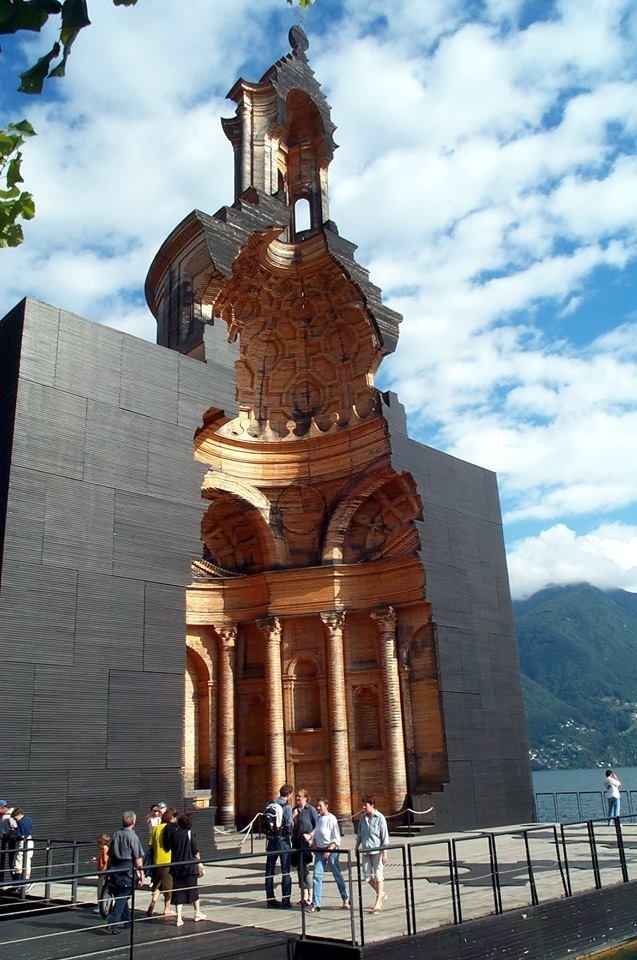
My kind of architecture is all about materials. The old form and content argument. We tend to forget this when drawing, but remember it when rendering, but the problem is that the rendering happens late, and the materials must really be considered early. Give me proper materials over form any day.
 |
| Not Kafka |
Another interpretation can be that at the start of a career arc there is a drive to push one's ego out there, a necessity in fact, so the songs about self and experience happen and the good ones survive and make it big. With time and maturity, the quality goes up, one gets better at the game of universality and the experiences accumulate and become more interesting. At the waning end, there must be a sense of overexposure, for those artists that don't get addicted to fame, and then there is the recluse phase, where universal themes become more tempting since they allow expression without self-revelation. Unfortunately, I think that unless you are Brian Eno and are interested in weird but cool stuff, the general world issue kind of stuff can be boring (not always to be fair..) and only established artists like Joni Mitchell can get it to be heard. Dunno, this is an anecdotal generalization. Must test against more data.
"What information consumes is rather obvious: it consumes the attention of its recipients. Hence a wealth of information creates a poverty of attention, and a need to allocate that attention efficiently among the overabundance of information sources that might consume it." (H. Simon, Communications and the Public Interest, 1971.)
Yes, but I would argue that that kind of A-D-D is good for art - innovation can come out of collision of cultures and of ideas.
About opponents of folksonomies:
Yes, his argument is strong, but ultimately it can be summarized as "the masses are stupid, I am smart".
I heard it from ultra-conservatives too - those that oppose Swiss style democracy, where every law is voted on by everyone.
He prefers "smart" people at the top interpreting what the populace wants - father/mother figures...
Statistically and historically, the argument does not compute. In signal theory one retrieves weak signals from noise through averaging. The noise cancels out.
This approach is the basis for democracy and for collective intelligence. We just need to find ways to cancel out the noise - the tools are just coming out...
Having said this, I still think that communities of interest are ways to avoid entropy in such systems.
Scientists discover that music "moves" the brain
Went to see a performance of the Magic Flute and was awed by the level of the music and performance. It transcends a lot of everyday achievement - as it should. The piece lasts about two hours, and is consistent throughout. Some thoughts, there are conventions used, understandings between the audience and the composer and performers, and these help set constraints for Mozart to play within or to push out. I had heard on Radio Canada about 30 years ago (Beaux Dimanches) a concert pianist say that pop music was really totally different than classical, and I know what she means, I keep getting reminded when I see live classical performances. The pianist at yesterday's performance was doing everything, had a synthesizer on the side that she used to do flute and glockenspiel while playing the main parts on the piano with an an extraordinary dynamic range. Too much - but somehow totally inspiring.
Then later at home I heard Dead Flowers interpreted by Steve Earle, and the words and music are powerful and fit extraordinarily well together although it is a parody of hillbilly music by the Sone's own admission. There is an element of truth that just comes out. And that can be as powerful as Mozart's stylized perfection.
"I've always been fascinated by the opposition between radicals and liberals," he says. "It's a tension that exists in all my plays, but there is never a final decision.
As a writer, you can't hope to change society. All you can do is shift people's perspective on what you see as the truth."
http://arts.guardian.co.uk/theatre/drama/story/0,,2042912,00.html
Inspiration?
Don't know if this is useful or not - worth a look I guess: Sources of inspiration
Songs about Thetans
There is a song here
Songs about pictures
There have been albums themed around sets of pictures, or purported to be: "The Six Wives of Henry the Eighth" by Rick Wakeman was inspired by the portraits at the National Gallery, "Pictures at an Exhibition" by the Rod - not so sure there... and some of Laurie Anderson's work has been themed around visual structures I think. Was thinking that some pictures could be good starting points for lyrics, i.e. to take an inspiring or evocative picture and to write a caption or story about it and then to make a song. It is a sort of second-order experience, but it may lead to something different at least.
Jasper Johns
Was interviewed for the New Yorker. He talks about his friendship with Rauschenberg and how their discussions fed their creativity, and he talks about inspiration and work methods. In the end, it is clear that he cannot explain the source or the inspiration, which is the way it often is.
'Asked about the worth of his art, Johns once stated: "To be plain, the best critic of a picture is another picture. I think that one wants from painting a sense of life. The final suggestion... has to be, not a deliberate statement, but a helpless statement. It has to be what you can't avoid saying." '
Perez-Gomez in his latest book
- which took 5 years (Boyd was involved in the first takes, and when he saw how difficult she was, he let someone else take over) - she went on to do other stuff, but never topped that one . Notable successes include the McGarrigles' first album, lots of famous folkies like Doc Watson, and R.E.M, amongst many many others, not all folk- since his real love is Muddy Waters and other roots guitar blues, in a career that spans the 60's to the 90's. His style is to make a studio album sound "alive" - which I guess means sort of like "live" but more polished. On a recent CBC interview, he said that he though that his biggest contribution was to make the recording artists feel that they could do anything, have freedom, and he would make it work, go with it, which was a radical thing in the 60's when producers had more power than today, since they were generally not hired by the artists but by the label. Things have changed, and he indicated that there was much self-indulgence today. I think I'll get the book.
Rules for guitarists
e.g. Rule_ 4. WALK WITH THE DEVIL Old delta blues players referred to amplifiers as the "devil box." And they were right. You have to be an equal opportunity employer in terms of who you're bringing over from the other side. Electricity attracts demons and devils. Other instruments attract other spirits. An acoustic guitar attracts Casper. A mandolin attracts Wendy. But an electric guitar attracts Beelzebub.